A backtest is an experiment
A backtest applies a stated set of rules to historical information. It is not a record of money actually earned. The CFTC has highlighted the limitations of hypothetical performance, including the difference between simulated and actual trading. Use a test to examine an idea and its weaknesses, not to manufacture a persuasive equity curve.
CFTC: discussion of hypothetical performance disclosures
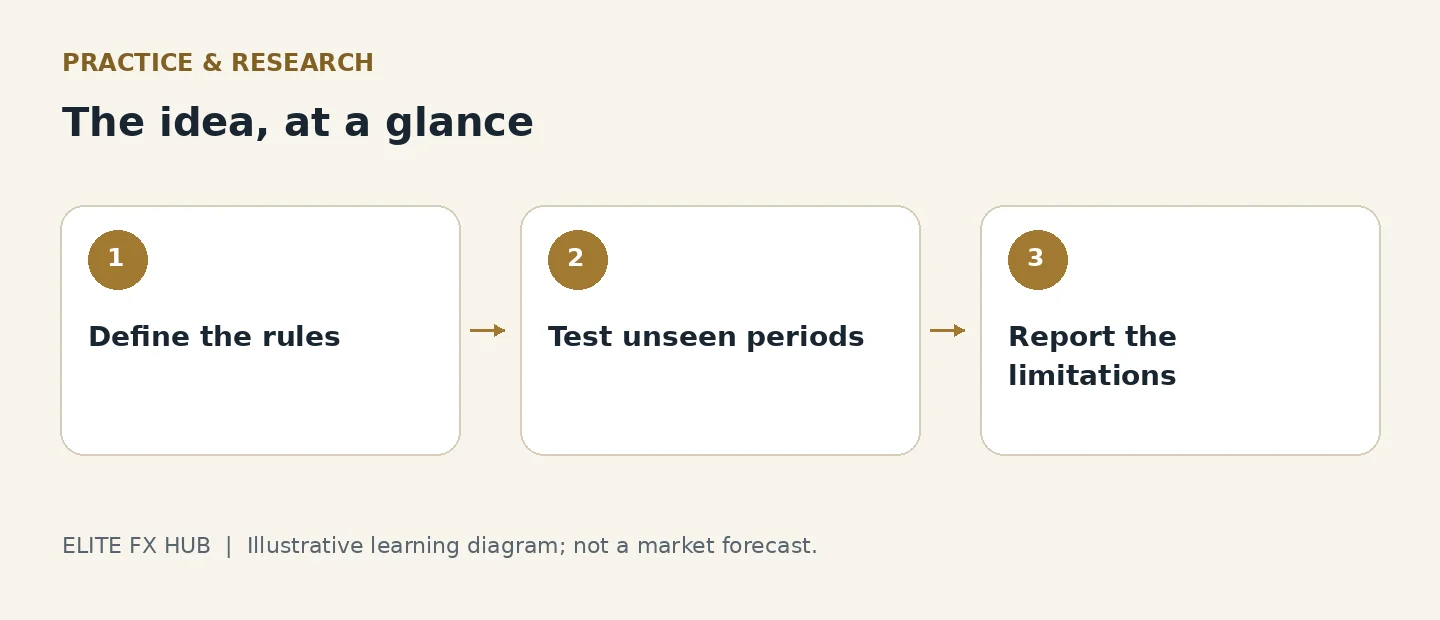
Write rules another person could apply
Define the instrument, time frame, entry condition, invalidation, exit and position-size calculation before inspecting the result. Replace phrases such as a strong move or a clean setup with observable conditions. If the rules depend on judgement, write down the decision criteria and retain examples of rejected as well as accepted setups.
Protect the information boundary
At each simulated decision, use only information that would have been available at that time. A completed daily candle is not available at the start of the day. A later swing high is not yet confirmed when the market first approaches it. Advancing a replay one step at a time can make these timing mistakes easier to notice.
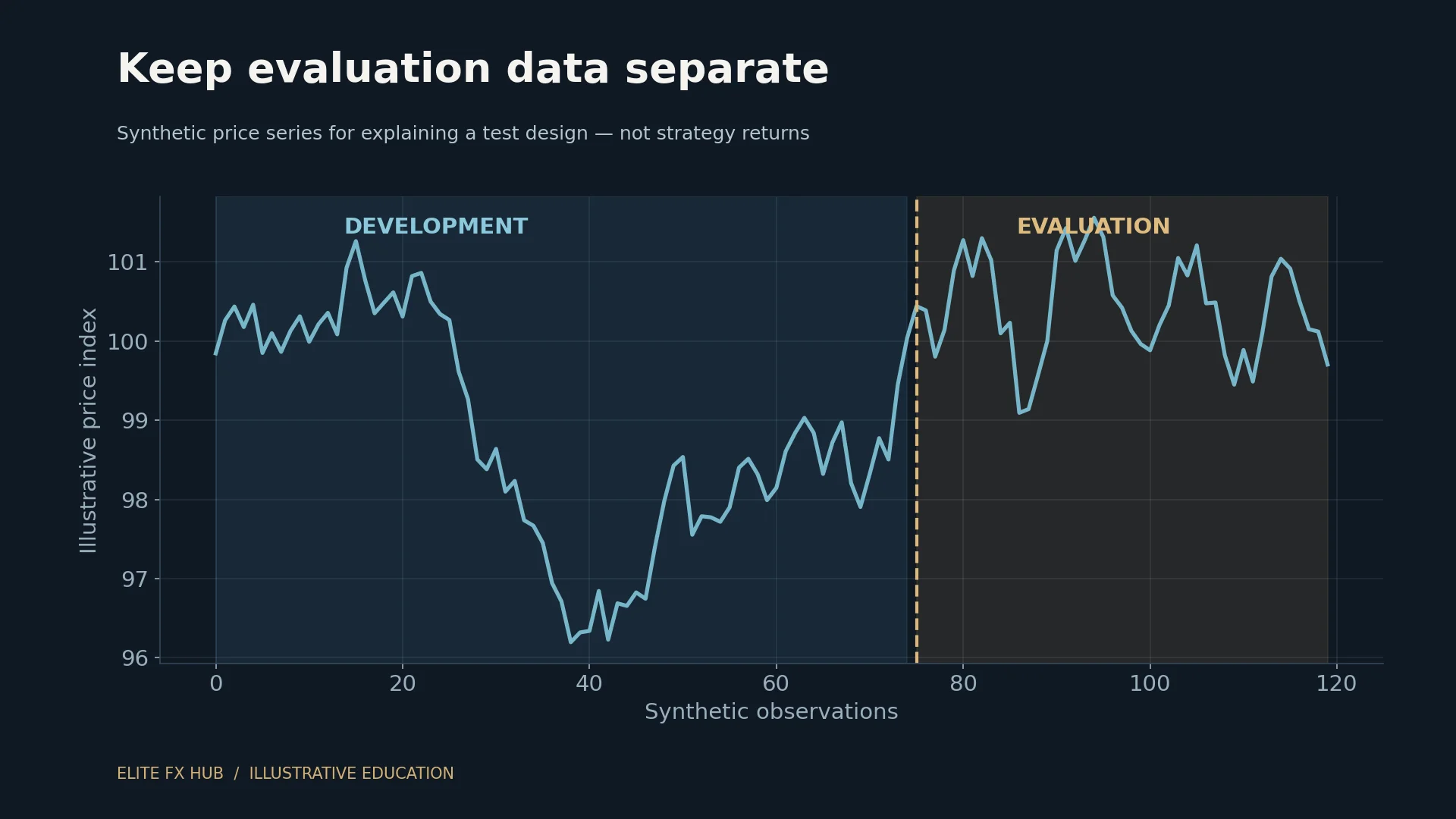
Reserve a separate evaluation period
Use one period to develop the idea and another, previously unexamined period to evaluate it. If you repeatedly change the rules after seeing the evaluation results, that period has become part of development. Record each version rather than keeping only the best-looking variation. No fixed number of trades proves that a strategy will work in the future.
Make the arithmetic honest
Include a defensible treatment of spread, commissions, financing and execution uncertainty. Record losing trades, missed fills and ambiguous cases. As a simple example, a gross average result of 0.15 risk units per trade becomes 0.03 after average costs of 0.12 risk units. These hypothetical numbers illustrate sensitivity; they are not evidence of a profitable system.
Report what remains unknown
Summarise the rules, dates, sample size, costs, largest drawdown and the market conditions represented. List missing data and decisions that could not be reconstructed reliably. A useful next step is observation or demo testing with the rules frozen. Keep real-money decisions separate from the excitement of a promising historical chart.
Sources and further reading
CFTC: discussion of hypothetical performance disclosures
Educational material, not a recommendation to trade. Examples are hypothetical. Leveraged products can produce substantial losses. Source links provide context and do not imply an endorsement of ELITE FX HUB.