
Use the calendar as preparation
An economic calendar identifies scheduled information, not a guaranteed trading opportunity. The US Bureau of Labor Statistics publishes official release schedules for reports such as the Employment Situation. Check the source calendar rather than relying solely on a screenshot or a time copied from a chat group.
Convert the time carefully
Record the stated release time zone and convert it to your own. Daylight-saving changes do not happen everywhere on the same dates. For example, Nairobi stays on East Africa Time, while some other financial centres change their clocks. Use a date-aware calendar conversion and verify it again when the event is close; avoid memorising a single year-round offset.
Separate the release from your interpretation
A report may include several measures, prior-period revisions and methodological notes. Write down which measure you are looking at before deciding what the headline means. The Bank of England explains that changes in interest rates influence borrowing and spending; that broad relationship does not make the immediate currency response to every announcement predictable.
Bank of England: what are interest rates?
Write an observation plan
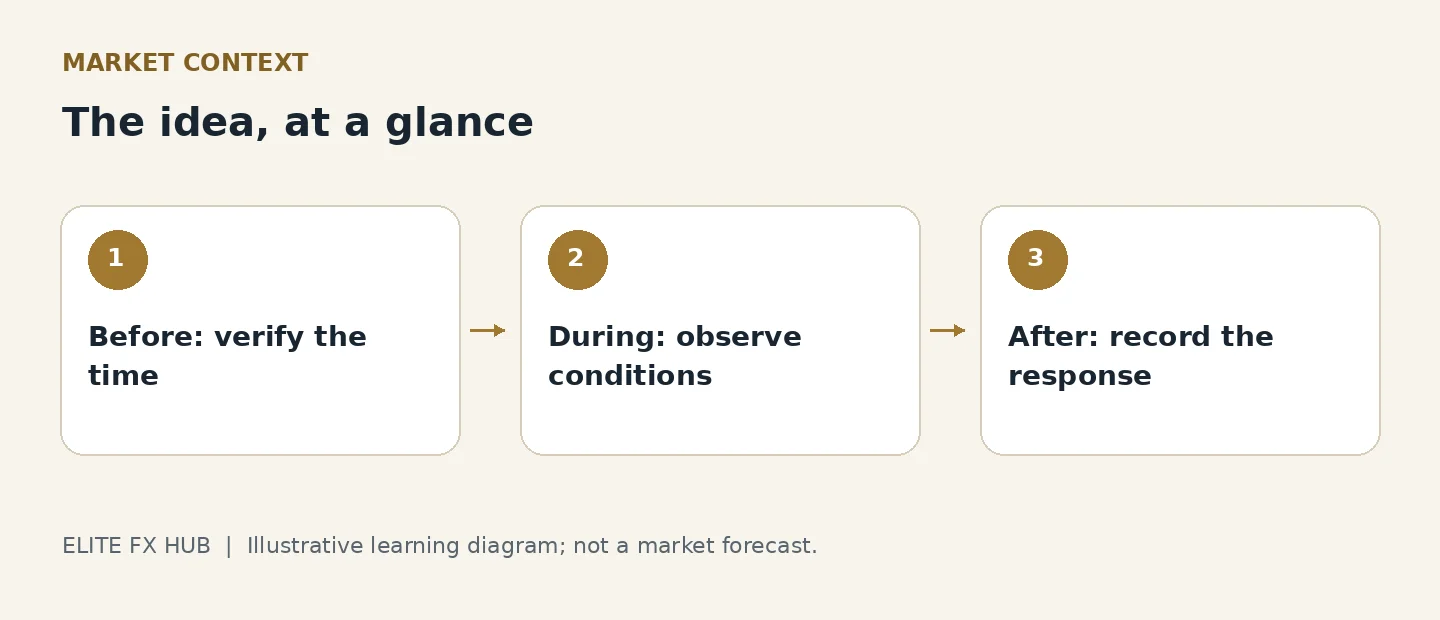
For a practice session, choose one scheduled event and one instrument. Before the release, record the current spread and decide whether you will simply observe. During the event, note changes in quotes and the availability of execution. Afterwards, capture the official release and a chart with timestamps. Keep the observations separate from a story invented after seeing the outcome.
Avoid a one-number rule
A stronger-than-expected figure does not automatically require a currency to rise. Market expectations, other information in the release and existing positioning can complicate the response. Treat any simple headline-to-direction rule as a hypothesis to investigate rather than a reliable instruction to trade.
Make the review specific
Ask whether the displayed time was correct, whether spreads changed, whether the first price move persisted and whether your planned behaviour was followed. If you did not understand the release beforehand, watching without taking a position is a complete learning activity. You do not need a trade result to learn how an event affects the trading environment.
Sources and further reading
BLS: Employment Situation release schedule
Bank of England: what are interest rates?
Educational material, not a recommendation to trade. Examples are hypothetical. Leveraged products can produce substantial losses. Source links provide context and do not imply an endorsement of ELITE FX HUB.