
Start with the unit
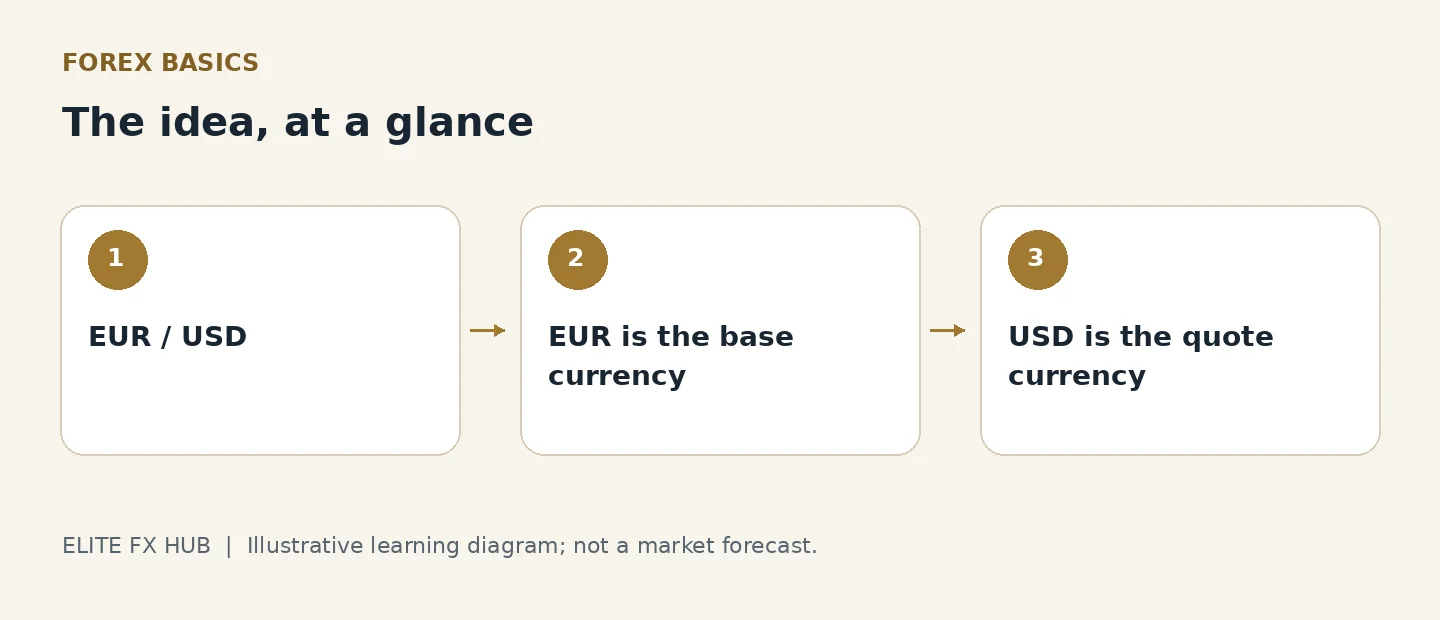
A currency pair expresses the price of one currency in another. In EUR/USD, the euro is the base currency and the US dollar is the quote currency. An illustrative price of 1.0800 means one euro is priced at 1.08 US dollars. It does not mean either currency is universally strong or weak: the comparison is specific to that pair.
What buying and selling mean
Buying EUR/USD creates exposure that benefits from a rise in the euro relative to the dollar, before costs. Selling the pair creates the opposite exposure. The instrument matters: a retail leveraged contract is not necessarily a delivery of euros into a bank account. Read its contract terms before assuming what you own or what obligations you have.
An example you can calculate
Imagine an unleveraged conversion of 200 euros at the example rate of 1.0800. Ignoring fees, that corresponds to 216 dollars. At 1.1000, the same 200 euros correspond to 220 dollars. The difference is four dollars. This arithmetic explains the quotation; it is not a trade recommendation or a prediction that the rate will rise.
Price is a comparison, not a verdict
The Bank of England explains that demand and supply influence floating exchange rates. A currency can rise against one counterpart while falling against another. Avoid turning a single pair's chart into a claim about every currency market. Also distinguish a chart's displayed price from the bid and ask at which your provider offers execution.
Bank of England: who sets exchange rates?
Try this on a demo screen
Write the pair exactly as displayed. Underline the first currency and label it base. Label the second quote. Then finish this sentence: one unit of the base currency currently costs approximately this many units of the quote currency. Repeat the exercise with a pair whose order feels unfamiliar, without placing an order.
Before moving on
Check that you can explain which relative movement would help a long position and which would hurt it. Record whether the screen shows bid, ask or a midpoint. Keep the quote, timestamp and instrument name together in your notes: a number without these details is difficult to interpret later.
Sources and further reading
Bank of England: who sets exchange rates?
Educational material, not a recommendation to trade. Examples are hypothetical. Leveraged products can produce substantial losses. Source links provide context and do not imply an endorsement of ELITE FX HUB.