
An order is an instruction
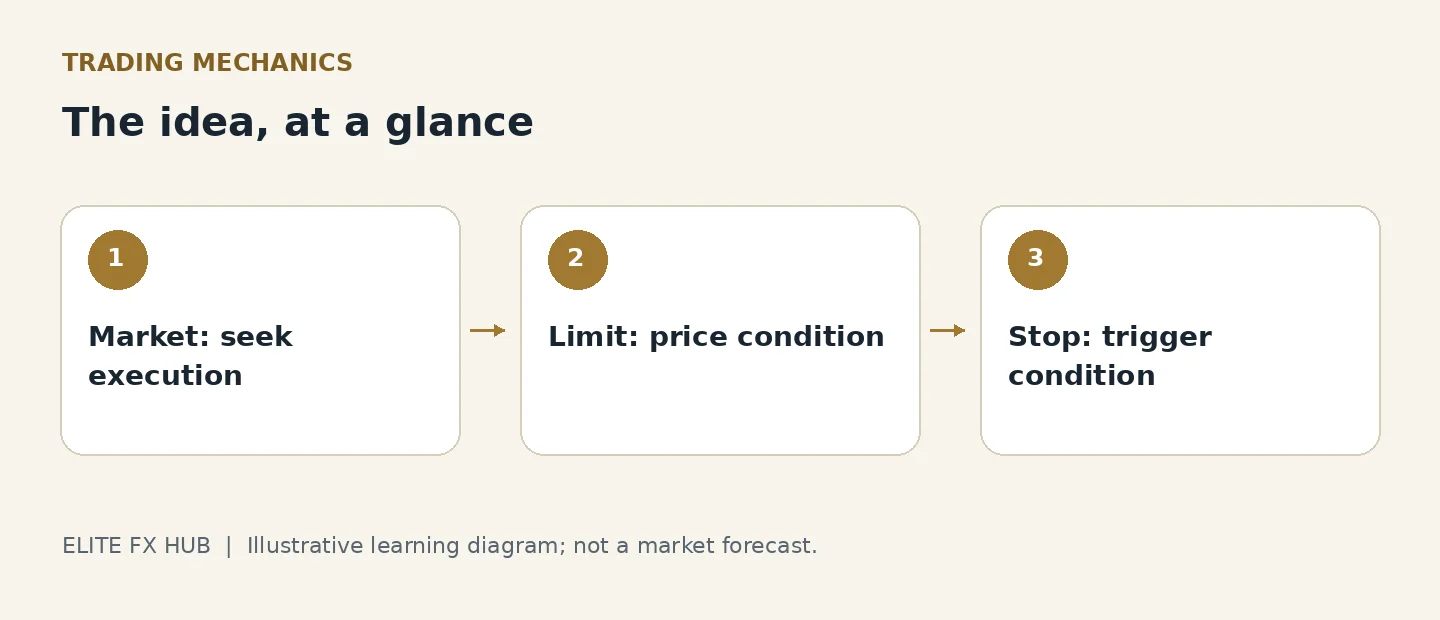
An order tells a provider what action to attempt under specified conditions. Investor.gov distinguishes market, limit and stop orders and explains that execution price is not guaranteed for a market order. Its guide concerns securities; forex providers may use different trigger conventions and execution rules. Always read the documentation for your own product.
Separate the trigger from the fill
Imagine a long position with an intended protective exit at 1.0750. A stop instruction may become active when the provider's defined trigger is reached. That does not establish the eventual execution price. In a fast move or gap, available prices may differ. The exact bid, ask or other trigger used by the platform matters.
A limit has a different trade-off
A limit instruction sets a price condition. It may remain unfilled when that condition cannot be met. A stop-limit instruction combines a trigger with a limit condition; the price constraint can leave the position open if the market moves beyond it. Do not choose an order type solely because its name sounds more protective.
Read the ticket before submitting
In a demo environment, identify the direction, size, order type, trigger price, limit price if applicable, and time-in-force. Find out whether the protective order is attached to the position or is an independent pending instruction. Understand what happens if you close the position manually or lose your internet connection.
Keep an execution record
Use an illustrative order to record three separate values: the planned price, the trigger observed in the platform and the actual fill. Add timestamps and any error or rejection message. A screenshot of a candle alone may not contain the relevant bid-and-ask information needed to explain the result.
A useful practice test
Place and cancel different pending order types in demo, using small simulated sizes and no real money. Explain aloud when each would become active and what it does not guarantee. If the provider offers a specifically guaranteed stop, examine its fee and eligibility terms rather than assuming every stop on the platform has that protection.
Sources and further reading
Educational material, not a recommendation to trade. Examples are hypothetical. Leveraged products can produce substantial losses. Source links provide context and do not imply an endorsement of ELITE FX HUB.